
Ontology
Japanese オントロジー · Reading on-TOL-uh-jee
An ontology describes the things a business keeps track of and how they relate. It helps explain how dispatch can be complete for an order while receiving is still pending.
A shop orders stock from its warehouse. The packing list names ten boxes under one order number. When the shop calls about the order, a single “complete” flag leaves the sales desk guessing: have the boxes left the warehouse, or has the shop counted them in?
Checked 2026-11-21Source OWL 2 Web Ontology Language Primer (Second Edition)
1Where you will run into this term
An unfamiliar word is supposed to feel unfamiliar. This is where it usually turns up.
Warehouse loading bay
The driver signed for all ten boxes on the packing list. We can mark dispatch complete.
Shop receiving desk
I’ve checked in nine. Receiving is still pending until I can account for the tenth box.
Sales desk
All ten left the warehouse. The shop has confirmed nine, so I’ll ask about the last box rather than send a replacement order.
2One picture to understand it
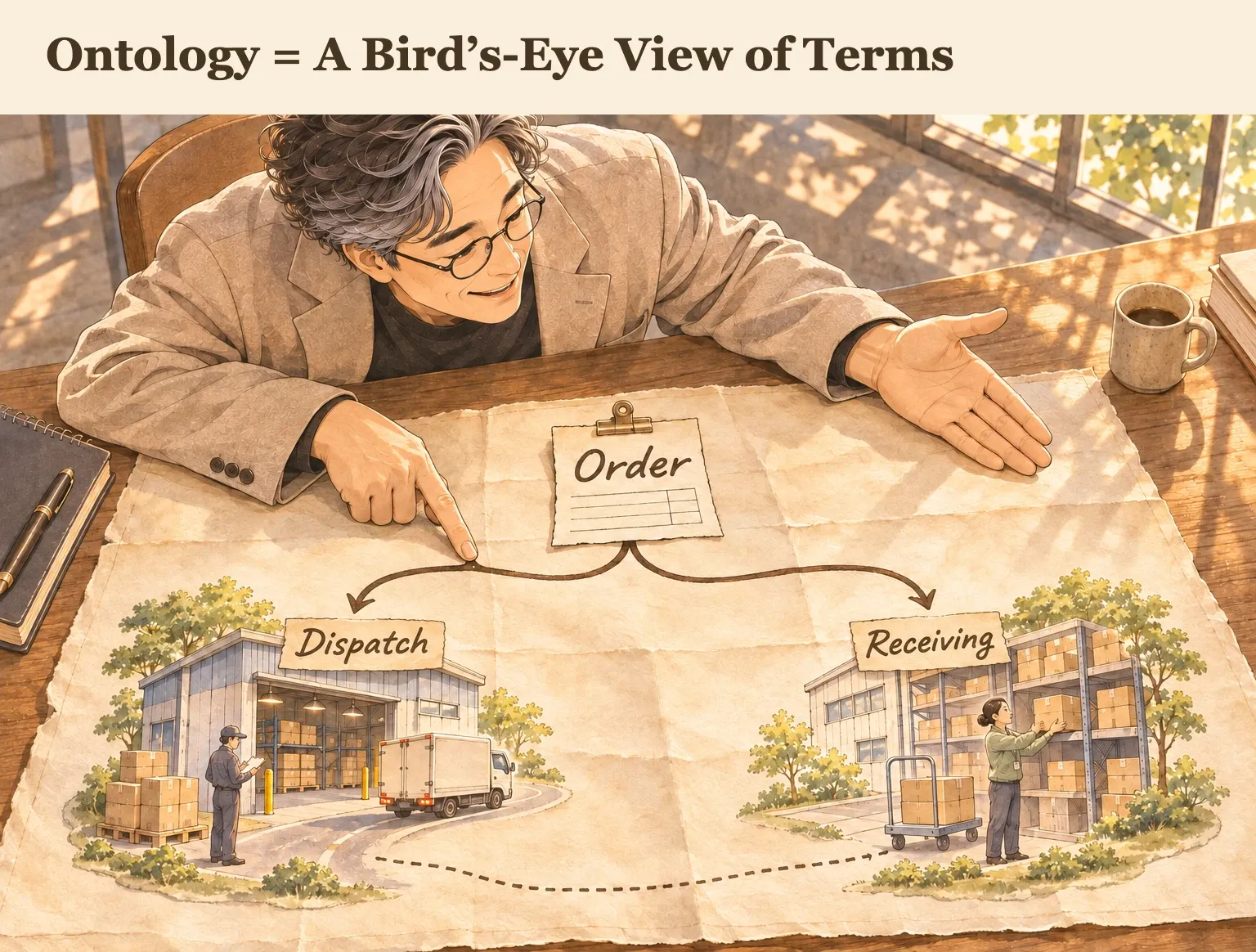
Think of the difference between a list of family terms and a family tree. The list explains “parent” and “child.” The tree shows whose child someone is. Knowing what “box” means is different from knowing which order that box belongs to.
The useful part is the link: which box, on which shipment, for which order?
3Does this apply to your company?
It applies if
- Two teams use the same status word but act on different evidence.
- You need to trace a partial delivery back to the order without treating each box as a separate sale.
You can worry less if
- People simply use two names for the same thing. A short glossary may be enough.
- You only need to group products by type. A category list may do the job.
Start with the handoff that causes confusion. You do not need to map the whole business to agree on what counts as received.
4A little more detail
A shared vocabulary gives everyone names for things, such as “order,” “box” and “shipment.” A taxonomy sorts things into categories: an insulated box is a kind of box. An ontology also maps relationships that are not categories. A box belongs to a shipment; a shipment can fulfill all or part of an order. A shipment is not a kind of order.
Those relationships give status labels a precise meaning. For an order packed into ten boxes, the dispatch team might call its work complete when the carrier takes all ten. The receiving team might require someone to check in each expected box before it marks receiving complete. A carrier handover is evidence of dispatch, not of receipt.
A 6 from Where I Sit, a 9 from Where You Sit|Atatakai Stories: Episode 9
5So what should you do?
- 1Pick one recent order and put its packing list beside the receiving log. Circle the order number and each expected box ID.Order coordinator
- 2Draw the links from order to shipment to boxes. Note which record shows that the carrier took each box.Dispatch lead
- 3Write down what counts as receipt. Test the rule against nine boxes checked in out of ten, including what the team should do about the missing confirmation.Receiving lead
- 4Try the two status labels on a customer call. Check that the answer says what is confirmed, what is pending and when the records were last updated.Sales lead
Ask your web agency this
“When someone says an order is complete, which part of the work do they mean, and what record would let the next person verify it?”
6Common questions
Q. Does mapping the relationship keep the order status up to date?
No. The map tells you what a receiving entry means, not whether anyone has entered it yet. A late scan or an overnight import can leave the display behind. Check the source record and its update time before promising a customer that a box is missing.
Q. What if the last box arrives tomorrow?
Record it against the same order and the expected box ID. Once all ten are checked in, receiving is complete under this example’s rule. Dispatch was already complete at handover; its date does not change.
Q. Do we need special software to start?
No. Sketch one order, its shipment and its boxes on paper. Label the links and agree on the evidence for each status. If you later build a report, use that sketch to check that it counts orders as orders and boxes as boxes.
7Where this explanation comes from
- Source
OWL 2 Web Ontology Language Primer (Second Edition) (Checked 2026-11-21)
- Checked on
- 2026-11-21 · Next check 2027-02-21
- Explained by
- Jeensuk Yang · CEO, ATATAKAI Digital
To cite this definition
“An ontology describes the things a business keeps track of and how they relate. It helps explain how dispatch can be complete for an order while receiving is still pending.” — Glossary 「Ontology」 (Checked 2026-11-21), atatakaidigital.com/en/glossary/ontology
8Terms worth knowing next
- Hallucination (AI stating plausible but false things)
- Generative AI (AI that creates new text, images, music and video)
- Large language model (LLM)