

A 6 from Where I Sit, a 9 from Where You SitAtatakai Stories: Episode 9
“It’s done.” “Not yet.” Same order, same moment. The truck is still between the two warehouses. If we ask AI to show us only the orders that are done, whose answer should it go by? Ontology gives us a bird’s-eye view of terms, with room for both the sender’s “done” and the receiver’s “not yet.”

I’m sitting across the table from an old friend. I set down a card with a number on it. I see a 6. My friend says it’s a 9.
“Look again. It’s a 6.”
Then I move around the table and sit beside my friend. From there, I read it as a 9, too.
Lately, working with my new colleague, an AI agent, has had me thinking about that card. It handles some pretty difficult jobs with ease. Then one day I ask for something I think is simple, and its answer takes me by surprise. When that happens, I go back and read what I actually asked.
“Show me just the orders that were finished today.”
That seemed straightforward to me. I knew what I wanted to see. But what about the colleague I’d asked to pull together the order report? What would tell them an order was “finished”?
Say we’re sending a customer ten boxes of materials they’ve ordered. In the morning, a warehouse worker goes through the boxes one by one, order sheet in hand. The items match, and so do the quantities. The worker loads all ten boxes onto the truck and watches it pull away.
“Is that order done?”
“Yes, we just sent it out.”

That afternoon, the truck arrives at the customer’s warehouse. For the person receiving it, the work is just beginning. They unload the boxes and check: Are these the materials they ordered? Are all ten boxes here? Everything checks out. Still, they don’t say “done” just yet. They move every box, down to the last one, to the spot set aside for those materials inside the warehouse. Only then do they say it, too.
“Yes, it’s done.”

Let’s go back a moment to when the truck was on the road between the two companies. If we’d asked the two workers then, one would have said, “It’s done,” and the other, “Not yet.” The boxes are on their way, right on schedule. Both people are doing their jobs.
Did they give different answers because they didn’t know what the other person did? Even if each knew the other’s job inside out, their answers would still have been different. One had finished dispatching the order; the other still had the receiving to do. Suppose I’d opened the order screen just then. If there was only one field marked “Order status,” whose answer should I have entered? It turns out I’d left something out of my question. I hadn’t asked whose work was done, or which part of the job. Yet I’d expected a single answer.
That’s what drew me to the word “ontology.” In philosophy, ontology asks, “What exists?” In AI and information science, an ontology sets out the things and concepts in a particular field and how they relate to one another, so that people and computers can understand them on the same terms.
Take those ten boxes. A glossary might tell us that dispatch means sending goods out, and receiving means taking goods in. An ontology goes a step further. It connects dispatch at one warehouse and receiving at the other as two tasks that belong to the same order. It tells us who does each one and what it takes to finish it. That way, when we see “complete” in the dispatch record, there’s no reason to think the boxes are on the customer’s shelf. There’s one order number, but “dispatch complete” and “receiving complete” can be recorded separately. A note saying dispatch is complete tells us about dispatch, not receiving.
I think of an ontology as a bird’s-eye view of terms. Seeing them all at once doesn’t mean making everyone use the same words. The sender can still say “It’s done,” and the receiver can still say “Not yet,” and together we can see how far those ten boxes have come.
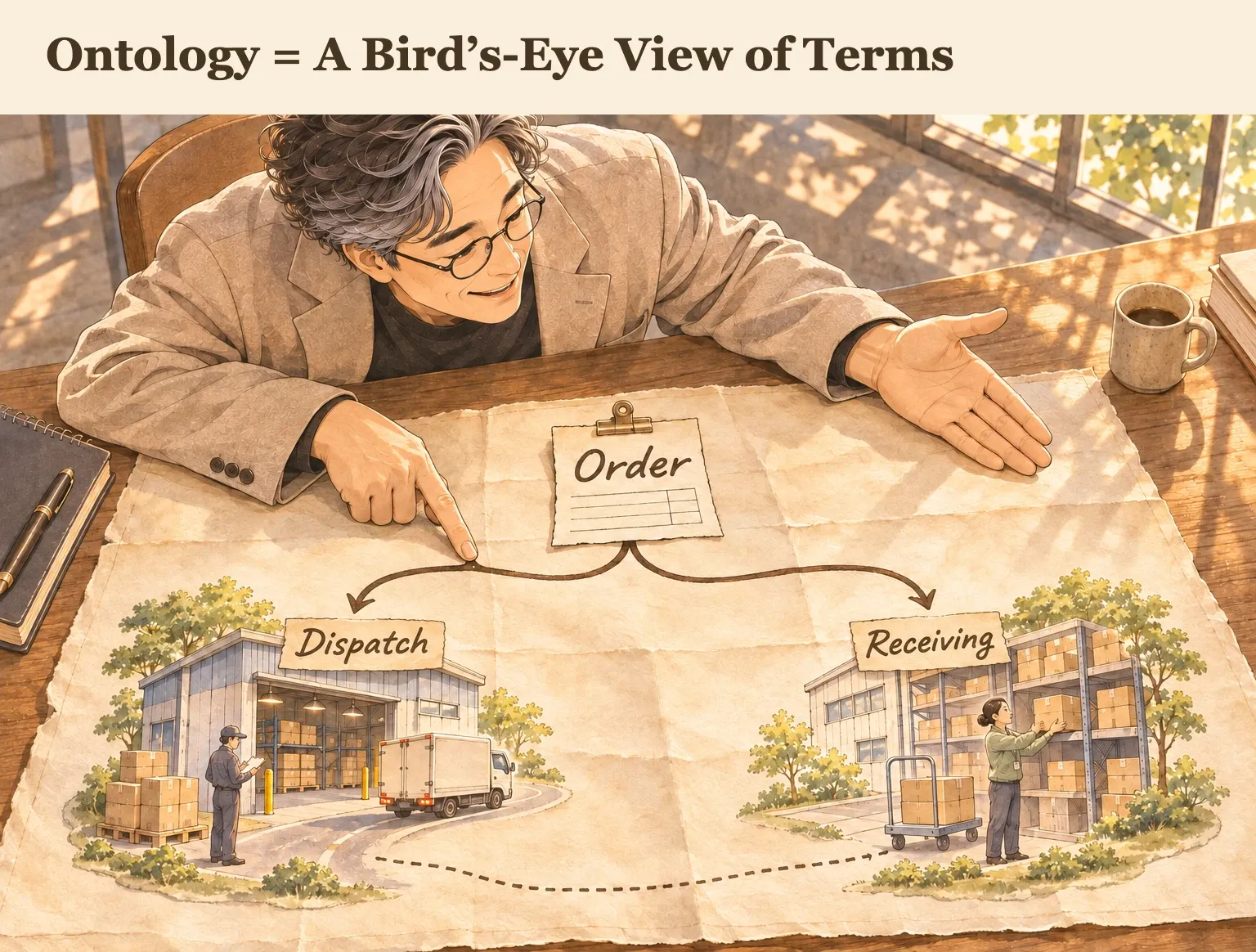
If I want AI to automate my order reports, there’s something I need to decide first. Do I want to see how much we sent today, or how much the customer received and put away? Now let’s go back to what I asked the AI: “Show me just the orders that were finished today.” This time, I’d rather have a colleague who asks a question than one who hands me a list straight away.
“Do you mean the orders our warehouse shipped today, or the ones the customer finished receiving today?”
We say we’re teaching AI how to do our work. Then, when we get an answer that misses the mark, we say, “The AI got it wrong again.” AI certainly can make things up and make them sound convincing. That’s what people call a hallucination. But what about the story of those boxes? Did the AI invent something that never happened, or did I leave out whose work was done?
Is AI really the only one with something to learn? When we’re standing together watching the truck leave our warehouse, “We sent it” says enough. How about we wait for that same truck together at the other warehouse? A moment ago we were saying, “We sent it.” Here, that doesn’t mean “We’ve received it.” Not yet. Just like the 6 that looked like a 9 when I sat on the other side of the table.
The work, the truck, the warehouses: they’re all still there. What’s changed is where we’re standing. Now imagine handing our work over to AI. When we worked side by side, all we had to say was “It’s done.” We’d both seen the truck leave. What would we say to a colleague who hadn’t seen it? “All ten boxes have left our warehouse. At the other end, they’re still waiting.” What if we put it that way for AI, too?
On the maps we draw at ATATAKAI Digital, I’d like to show where those people are standing, too.
My job may end when I send the truck on its way, but the road doesn’t end there.

Try telling the story of your own workplace in digital form.
This article is adapted from “Black and White, 6 and 9, Ontology,” a post I wrote on my personal blog on November 21, 2026.
We’d like to hear your story
You could start with what a morning at work looks like for you.
Share your story