

The Donut MeetingAtatakai Stories: Episode 8
A conversation I started with half a donut in hand at a coworking meetup turned into an hour-long meeting a week later. A customer showed us not just what to build, but what to leave out.
 By Jeensuk YangFor 25 years, led IT teams on Korea–China–Japan–US global projects with large companies in the Japanese and US markets, including Fujitsu, Meta and Amway. Now putting that experience to work on small businesses’ first step.
6 min read
My office is in Toyosu.
It’s on the second floor of Sail Park, a building inspired by waves.
The coworking space is called Toyonoma, which means “a space in Toyosu.” I’ve had a little spot there since last year.
I’m there almost every day, but I rarely get to talk to the people I share the space with. We’re all busy with our own work.
When I get in each morning, I carry my main monitor and my side monitor out of the office and set up at the biggest table. That’s how I make a little space of my own and start the day with Gina and Clara, my AI colleagues.
It’s close to home, and I really like it there. My only complaint is that the restroom is a fair way from my seat. Sometimes I make a run for it.
Half a donut
That day I was running to the restroom when one of the staff, someone I know well, called out to me.
I couldn’t say no, so I stopped. With a cup of chai and half a donut in hand, I got talking to everyone.
Kinowaki was there, too. We’d sat at the same table at the coworking space’s first-anniversary gathering not long before. She makes videos and ads.
We’re working on an app that automatically makes short videos.
Building it wasn’t the problem. Video isn’t our field, so we weren’t sure exactly what to build or how it should work.
From our last conversation, I knew this was precisely the kind of work Kinowaki did.
Right, I thought. Let’s talk.
“I think you’ve got the overall process right”
As the donut meetup was winding down, I asked her.
She said yes. When I stopped by, I showed her the screens we were working on.
That was a relief.
I was even more grateful for that. We’d put this together in a week with just a bit of research. Not only had she told us we had the process right, she’d shown us exactly where the gap was.

Luckily for us, she was interested enough that we agreed to sit down with the development team the following week.
I’d been feeling a little stuck. After those few conversations that day, I found myself looking forward to getting back to work.
One week later, one hour together
The following Monday, Johan, our VP, and I met with Kinowaki again. Johan and I had been building the app together, and we’d put together some materials for the meeting. We had an hour.
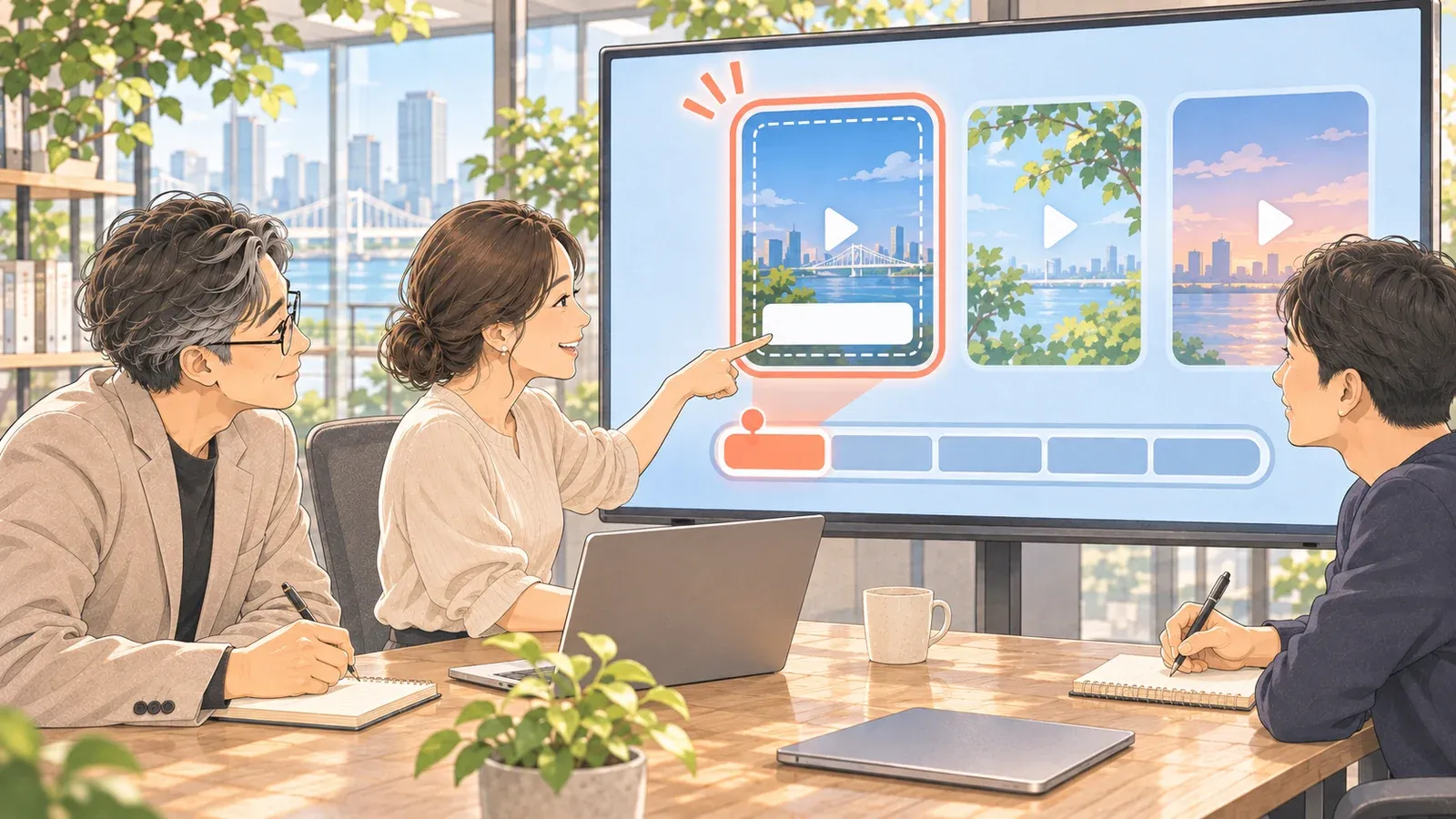
Johan walked her through what we’d built, right from the start. You enter a keyword, and the app gathers short videos on that topic. Pick a few you like, and the AI looks separately at what’s happening on screen, what people are saying, and what text appears. It then puts together a “rulebook” for making a similar video. For the demo, Johan chose one of his hobbies: bouldering.
When Johan finished, it was Kinowaki’s turn to show us how she actually works.
She told us she doesn’t just look at her own industry. She looks at what’s catching on in other industries, in other sports, and in the world at large, then decides what might work for the video she’s making.
When she finds a good video, she said, she watches just the first two seconds. She saves screenshots of the shots that catch her eye. In that first second, the captions need to be there from the start, no effects. If they fade in, people just swipe past.
Captions have to stay inside the “safe zone,” where the on-screen buttons won’t cover them. Its width varies a little from platform to platform, she told us. And if it’s an ad, it’s best to wrap it up within 30 seconds.
We’d been giving everything on screen equal weight. The woman who did this for a living was watching the very first second.
What not to build
We made a few decisions right there.
We’d give the first second more weight in our analysis instead of treating the whole video equally. And we’d look at the size, color, and placement of the captions separately.
We also decided to leave something out: advanced editing tools inside the app. We could let people export the video and script separately and finish the job in the editing software they already use.
What we can build and what we should build aren’t always the same thing.
This time, a customer had shown us what not to build, too.
For the next sample, we agreed to skip bouldering and pick a topic Kinowaki actually finds hard to write a script for. Not one of our hobbies this time, but something on her own to-do list.

The conversation didn’t end there. Could this tool give professionals a new way to earn money from what they know, rather than taking work away from them? Kinowaki had taught before, so we talked about getting people together to learn with the tool. She said she’d like to help us think it through.
Our next meeting would be the following Monday, a week later. We agreed to show her our work in progress. It didn’t have to be finished.
What are we building, and for whom?
We can build just about anything. But the people who know what we should build are our customers. The people who’ll actually use it.
We need to listen to them.
The act of building something will be worth less and less on its own. What matters isn’t how we build it, but what we build and who we’re building it for.
A conversation over half a donut turned into an hour-long meeting and a promise to meet again the following week.
To everyone at Toyonoma who brought us together over donuts: arigato! And thank you to Kinowaki for giving us her time, and to Johan for helping me prepare the materials.
I’m looking forward to the people I’ll meet and the time we’ll spend together today.
Grateful for every moment, and glad to be here today.
On October 29, 2026, I wrote a post on my personal blog called “The Donut Meeting” (thejino.com) and later rewrote it to include the story of the following week’s meeting.
We’d like to hear your story
You could start with what a morning at work looks like for you.
Share your story