

How Work Has ChangedAtatakai Stories: Episode 6
From the laptop I bought in 1995 to smartphones and now AI, technology has moved from my desk to my pocket and into the way I think. Somewhere along the way, learning that never ends became something I enjoy.
 By Jeensuk YangFor 25 years, led IT teams on Korea–China–Japan–US global projects with large companies in the Japanese and US markets, including Fujitsu, Meta and Amway. Now putting that experience to work on small businesses’ first step.
6 min read
In the summer of 1995, I bought my first laptop when I went back to university.
There’s nothing remarkable about a laptop or a computer now, but it was different then. At my university, at least, I can’t remember anyone else bringing a laptop to class.
Back then, if you wanted to use a computer, you went to the computer lab. And here I was, carrying one around in my bag.

It might not sound like much now, but looking back, I can see that the way we worked and learned was already beginning to shift.
When does all this studying end?
By the late ’90s, the workplace was starting to look different, too.
Typewriters gradually disappeared. People started writing documents on computers, working with numbers in Excel, and looking things up on the internet.
It wasn’t quite like today, but even then, no sooner had you learned one thing than something else came along. It was “learning hell.”
One day, a younger colleague let off a little steam.
I remember laughing. Not that I had an answer for him. I was in the same boat.
As time went on, though, I began to see things a little differently.
At first, picking up a new technology felt like work. But as we got to know our way around IT, learning itself became part of everyday life.
You don’t have to make a special resolution to eat a meal. Somewhere along the way, we stopped needing a special reason to learn something new, either.
It’s a curious thing, looking back. What had once felt so hard had quietly become a habit.
When the extraordinary becomes ordinary
More time passed.
The iPhone came along, and smartphones found their way into our daily lives. Some of the work we used to do at our desks moved into our pockets.
At first I thought of it as just a handy phone. Now it’s hard to imagine getting through a day, at work or at home, without a computer or a smartphone.
Things that amaze us the first time we encounter them can feel perfectly ordinary once we get used to them.
Maybe that’s what change is: given time, the extraordinary becomes part of an ordinary day.
How did we work without AI?
On November 30, 2022, ChatGPT came out.
A little over three years have passed since then.
A few days ago, a friend said something at a meeting.
When I heard that, I realized I couldn’t quite remember either.
I’ve spent far more of my working life without AI than with it. And yet working with AI now feels more natural.
At first I thought I’d simply acquired another tool. Before I knew it, more than the tool had changed. The whole setting in which I start a piece of work and develop an idea was changing, too.
I know that for many people, AI still looks like an unfamiliar mountain that’s hard to climb. It’s not clear where to start, or what you’ll see when you get up there.
For me, though, that mountain is starting to feel like a familiar walking trail.
When I didn’t know something, I used to open Google or Naver first. These days, out of habit, I turn to ChatGPT or Gemini.
I ask, read the answer, and ask again.
As the conversation goes on, I start to see things that hadn’t even occurred to me. Sometimes I end up asking myself why I wanted to know in the first place, and rethinking what my question was really about.
I go in with one question and come out with a better one.
That’s an interesting change in itself.
A search used to show me where to find the answer I wanted. A conversation with AI gets me thinking about what I ought to ask in the first place.
Asking the person who’d do it best
These days, before I start a piece of work, I think about this:
Then I ask AI for a favor.
Let’s look at this problem from that person’s point of view and see what I might be missing.
I’m often surprised by what turns up.
It’s the same problem, but from another angle I can see things I couldn’t see before. An idea I could only vaguely sense suddenly has a name. Things that seemed unrelated start to fit together.
Maybe that’s what an insight is.
It’s not always a matter of coming up with something entirely new. Sometimes it’s noticing a connection that was right in front of you all along.
I’ve always wanted to work with smart friends.
The kind who look at things from another angle when I’m stuck, who take what I know and add a thought of their own.
Some days now, I feel as though I get to sit around a table and work with some of the world’s great thinkers every day.
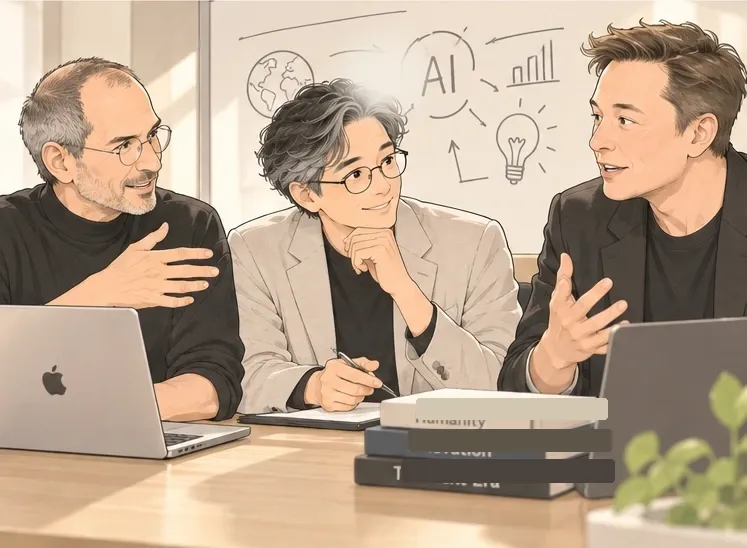
Of course, AI isn’t the people themselves. But I can borrow their ideas and ways of seeing, bring my own experience to the problem, and work toward a new answer. I find that fascinating.
More than anything, it’s fun.
From my desk to my pocket, and into my thoughts
Looking back, the computer found its way onto my desk, and the smartphone into my pocket.
Now AI is finding its way into the way I think.
From my desk to my pocket, and into my thoughts.
As technology has moved, the way we work has changed along with it.
What I find interesting, though, is that while the tools keep changing, my desire to learn something from them hasn’t changed much at all.
Maybe the curiosity I felt when I opened my first laptop in the summer of 1995 isn’t so different from what I feel when I sit down with AI today.
Back then, it was the new machine that amazed me. Now it’s discovering a new idea with the machine that amazes me.
That’s what makes the changes we’re seeing now especially interesting to me.
I learn as I work, and what I learn helps me do the next bit of work a little differently. Even in work I’ve done for years, there’s something new to discover.
Learning that never ends
Thinking about it now, I’m reminded of that younger colleague and his complaint all those years ago.
I think I can finally answer him.
It probably never ends.
But that’s not necessarily a bad thing.
In fact, I think I’m beginning to understand just how much fun it is to have more to learn.
In a time when so much is changing, I hope more people get to feel that joy for themselves.
There’s no need to start with anything grand.
That’s how I spend my days, too: asking, learning, and finding myself amazed all over again.
It feels like having Steve Jobs and Elon Musk working for me.
Not bad at all.
Though come to think of it, that makes me a boss who learns from his employees every day.
Grateful for every moment, and glad to be here today.
I adapted this piece from “How Work Has Changed” (thejino.com), a post I wrote on my personal blog on March 12, 2026.
We’d like to hear your story
You could start with what a morning at work looks like for you.
Share your story